Everyone says they love butterflies, so why aren’t we doing more to save them?

Updated: Jul 24

By Staci-lee Sherwood
If you live in a cold climate you know one of the first welcome signs of Spring is the sight of butterflies. If you live in a warm climate butterflies are year round residents. It’s thought the butterfly first appeared during the Eocene epoch, about 40-50 million years ago according to discovered fossils. Their development is linked to the evolution of flowering plants which exploded onto the scene about 70 million years ago. Butterflies and moths belong to the Lepidoptera family of insects. Moths predate butterflies by tens of millions of years, the oldest fossil of a moth is just shy of 200 million years old during the Jurassic period (think T-Rex). It’s amazing to think moths, tiny and fragile, were around during the dinosaur era, the largest animals ever to roam Earth next to some of the smallest.
Timeline of butterflies and moths

By the numbers
A recent study published in Science confirmed what we already know, that populations of butterflies across the U.S. are decreasing. In addition to dramatic declines for individual species, the study concluded the total abundance of butterflies has declined by 22% between 2000 to 2020. This spells bad news for butterflies as population decline means less genetic diversity. It’s also bad news for birds who depend on butterflies as a vital staple of their diet. In the U.S. there are 750 known butterfly species, worldwide there are over 17,000, and we need every butterfly. Click here to read the study. https://www.science.org/doi/10.1126/science.adp4671
For some species the drop is even more dramatic. The Monarch butterfly has served as an icon for butterfly enthusiasts for its beauty and unique wintering behavior. Their amazing journey down to Mexico to winter for several months before returning to the US and Canada has captivated people for decades. We now know that not all monarch populations migrate to Mexico, only those east of the Rockies in North America do. Monarchs that live west of the Rockies migrate to the southwestern coast of California.
Wintering in warmer climates helps monarchs survive to breed another generation because they can’t survive cold temperatures. In Mexico the monarchs roost together in the Oyamel Fir forests. This species of tree is thought to be a key factor in why the monarchs travel to specific areas in central Mexico where they’re found. But why does the monarch, and not other butterfly species, have this type of lifecycle? Many other species of butterflies and moths can’t survive the cold either but they don’t travel down to Mexico. If the weather was the only reason wouldn’t they just winter in Georgia, Florida and Texas like other species? Butterflies in cold climates either travel shorter distances to warmer temperatures or go into diapause, think butterfly hibernation, until spring. The mysteries as to why certain populations of monarchs winter only in specific areas of Mexico still remains locked away as the unraveling of all their behaviors still waits to be answered.
As open space becomes new shopping malls and subdivisions pristine habitat for butterflies is lost. Indiscriminate development can wipe out a field of wildflowers when developers come in and remove all vegetation. Shrinking habitat pushes more butterflies to compete for food, space to lay their eggs and food for their caterpillars. It can also lead to inbreeding since butterflies stay close to a consistent food source instead of venturing out to new territory. Butterflies require a diverse selection of nectar flowers for food but specific host plants to lay their eggs. Nature has designed both to occur organically which is lost with development.
We can’t turn back the clock on overdevelopment but we can help mitigate the problem for butterflies by planting lots of wildflowers wherever there is a patch of grass. Open fields, private gardens, grassy medians on the roads, open areas along the highways or any green space around buildings/schools or playgrounds can all be a mini buffet for butterflies. If they can’t find a large open area with food a patchwork of small areas with food close together would work. This is also important for migrating butterflies as they leave known food sources in search of warmer weather.
A Ruddy Daggerwing and a Delaware Skipper share space on a Buttonbush

Toxic gardens
A big culprit in declining populations is the use of pesticides. The toxic cocktails are sprayed by homeowners on their gardens and lawns, municipalities spray surrounding trees and flowers and then there is aerial spraying for mosquitoes. Butterflies can end up being sprayed directly but also poisoned when they feed on sprayed flowers. For the caterpillars, if the eggs hatch, they are forced to feed on poisoned leaves and die. Death by poison is agony no matter how small the victim. An organic garden insures both egg and caterpillar survive.
The growing use of non native plants can be another death sentence. Endemic butterflies know instinctively what and where their host plants and nectar flowers are. When non natives are planted they don’t know it’s food and ignore it. Some native plants can have a non native version which often confuses both a person shopping at a nursery and the butterflies. Take for example milkweed which s the host plant for monarchs, they can’t lay eggs on any other plant. In the U.S. there are about 70 native species with monarchs using about half of them as host plants. However several popular non native milkweed plants are also sold, like tropical milkweed, so it’s best to research what your local nurseries sell to insure you buy a native plant. Monarchwatch has a great resource map for each region of the U.S. where you can find what milkweed species is best suited to your area (cold, warm, dry). If you can’t find the plant you can find the seeds.
A Ruddy Daggerwing uses their camouflage effect of looking like a dead leaf when their wings are closed.

As we continue to spray the Earth with dangerous toxins like pesticides we kill not only the butterflies but ourselves. Why do we keep using these dangerous unnecessary products?
Look for the microscopic jewels
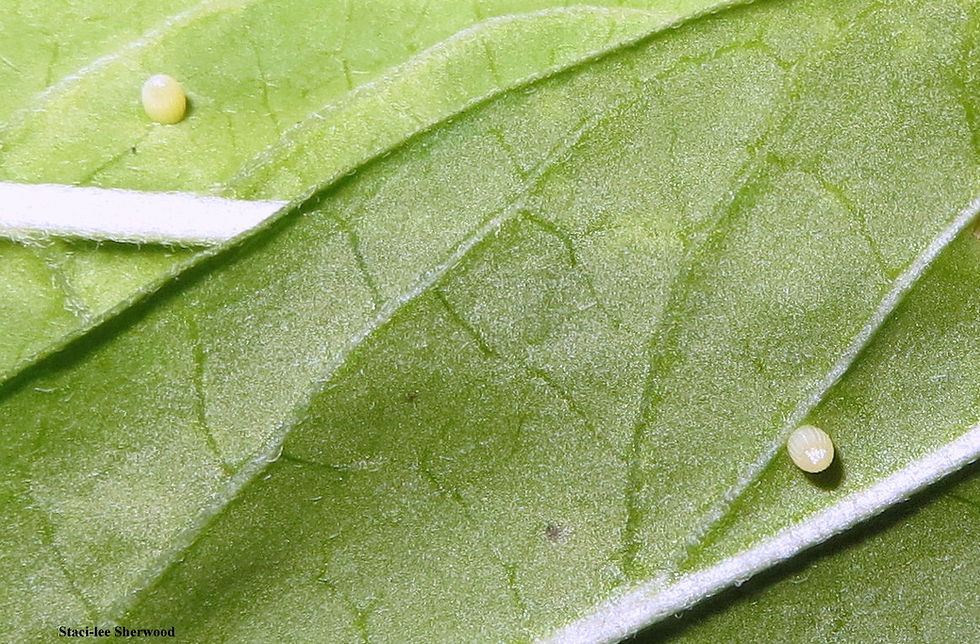
If you have host plants in your garden it’s easy to see butterflies but hard to see their eggs. Many species place a single egg on the underside of a leaf or on a stem, while others lay their eggs on top of leaves, often laying multiple eggs. Butterfly eggs are the size of a ballpoint pen tip. They come in different colors and shapes and usually hatch in 4 days. They’re designed to withstand the elements of nature but are still very fragile. If you prune your plants first look for any eggs before removing a leaf. When watering the plants it’s best to water the soil and not directly onto the plants and leaves.
A Monarch lays a single egg on the underside of a milkweed leaf

Monarch butterfly eggs on milkweed
You can’t have butterflies without the caterpillars
Newly hatched caterpillars aren’t much bigger than the size of two ballpoint pen dots. Colors range from cream and bright yellow to green but like the eggs can be tough to spot. Though tiny at first they grow very fast when food is abundant and can reach the size of two inches in fourteen days. Caterpillars, like the Zebra Longwing, are born solid yellow but as they grow turn white with black spikes. One of the roles of caterpillars is food for birds. It can be heartbreaking to see a bird take one but nature has designed it that way. They too are fragile so when pruning and watering survey the leaves and stems for any caterpillars beforehand.
A newly hatched Gulf Fritillary caterpillar, barely the size of 2 ballpoint pens dots

A Sleepy Orange laying an egg next to a caterpillar, green to camouflage itself against the leaf

A Zebra Longwing chrysalis about to hatch

An Orange-barred Sulphur female ecloses on a twig

How to save butterflies
Never use pesticides in your garden
Research what native species of butterflies are in your area and then plant their host and nectar plants.
Before buying any plants or seeds ask if any plant has been sprayed, most nurseries do spray plants but there is rarely a warning label. Many organic nurseries do not spray the plants themselves but don’t always know if the grower/shipper has sprayed them. It’s best to buy butterfly plants from a nursery that grows them. If that isn’t possible next best thing is to keep any new plant covered for 2-3 weeks so any residue wears off.
Plant only native organic non-gmo host and nectar plants to attract and feed them. If plants aren’t available buy the seeds.
Be careful when watering plants, never use a strong stream on them instead water from below
Look for eggs and caterpillars before doing any pruning of plants
Remove any leaves covered in mold or mites as that can make the caterpillars sick
Caterpillars that vomit green have consumed leaves with pesticide residue and won’t survive. Unfortunately the most humane thing is to remove them and end their suffering. This also means the plant has been sprayed and not a good food source for other caterpillars.
If you don’t have a garden but want to help look up what native wildflowers are in your area and plant them anywhere there is open space. Check out your state’s local native plant society for details.
Get local schools involved in planting a butterfly garden. It can be a living science lab and a boon to education
Great resources for more information:
The North American Butterfly Association, has state chapters
Click here for a great resource on region specific plants, restoration and establishing a pollinator habitat
For more info about monarch butterflies
Also published on All-creatures on January 14, 2026
Also published on The Good Men Project on February 2, 2026


Comments