The magical world of moths – they’re anything but drab and boring


By Staci-lee Sherwood
Most people are fascinated by butterflies but not so much with moths. It’s because while butterflies have grabbed most of the good press, the moth is mostly thought of as a drab pest drawn to our outdoor lights. Most moths are drawn to light but only the nocturnal ones, day flying moths sleep at night just like their butterfly cousins. They’re anything but drab. Their vivid coloring matches any butterfly with hues of red, purple, blue, yellow and green with intricate designs to match. The smallest moth is smaller than the smallest butterfly and the largest moth is larger than the largest butterfly. Unlike their cousins many species of moth are born without a mouth and never eat.
They belong to the Lepidoptera family of insects. Their arrival on Earth predates the arrival of the earliest known butterfly by about 100 million years, even predating flowers. The fossil of the first known moth species is about 200 million old. It was always assumed that moths and butterflies evolved after flowers, which first appeared about 50 – 70 million years ago but that is no longer true. The earliest moths first used their long sucking proboscis to find nutrition by drawing off water droplets from the tips of young gymnosperm seeds. Over time flowers developed as the moth developed into a pollinator for flowers. Moths can be found in almost every country from Canada to Europe, Africa and Australia and have 170,000 different species. So moths are anything but drab and boring. Like most insect species their population is in decline due to habitat loss, development and use of pesticides.
Lifecycle of moths
The cycle of life for moths is similar but not the same as it is for butterflies. Like their cousins they live a short life, can lay thousands of eggs and have specific host plants for each species. Their differences are in how they transform from caterpillar to flying adult. While the butterfly makes a chrysalis that hangs from a branch or leaf the moth makes a cocoon that is buried under leaves, dirt or even a flower pot. The chrysalis takes about 10 minutes once the caterpillar starts but the cocoon can day over a day to make. Another significant difference is the group of moths called ‘silk moth’ does not have a mouth and never feeds as an adult. Butterflies fly during daylight but moths can be either nocturnal or day flyers. Butterflies lay one egg at a time while moths lay several rows of eggs together.
Once the eggs are laid they take just a few days to hatch. The tiny caterpillars get right to work munching on their host plant. As they eat and grow they shed their skin several times, often changing the color and pattern each time. A newly hatched moth caterpillar rarely resembles itself after two or three weeks when it’s big enough to make a cocoon and go on to the next phase of life.
A moth caterpillar will find a dark quiet place to transform. They prefer to be buried under something hiding from predators. The process takes one to two days as the caterpillar buries itself than liquefies inside. Depending on the species the moth will eclose in a few weeks crumpled and wet. They crawl to where they can hang down, the blood travels through its wings as they dry and harden for flight. After a few hours the moth is dry and ready to fly away in search of food and mates. After a few days or weeks of mating and laying eggs the process begins with a new generation.
A Polka-dot wasp moth lays eggs on their host plant Oleander. Wasp moths are moths that mimic wasps

Newly hatched Polka-dot caterpillars next to hatched and unhatched eggs

Polka-dot caterpillar making his cocoon
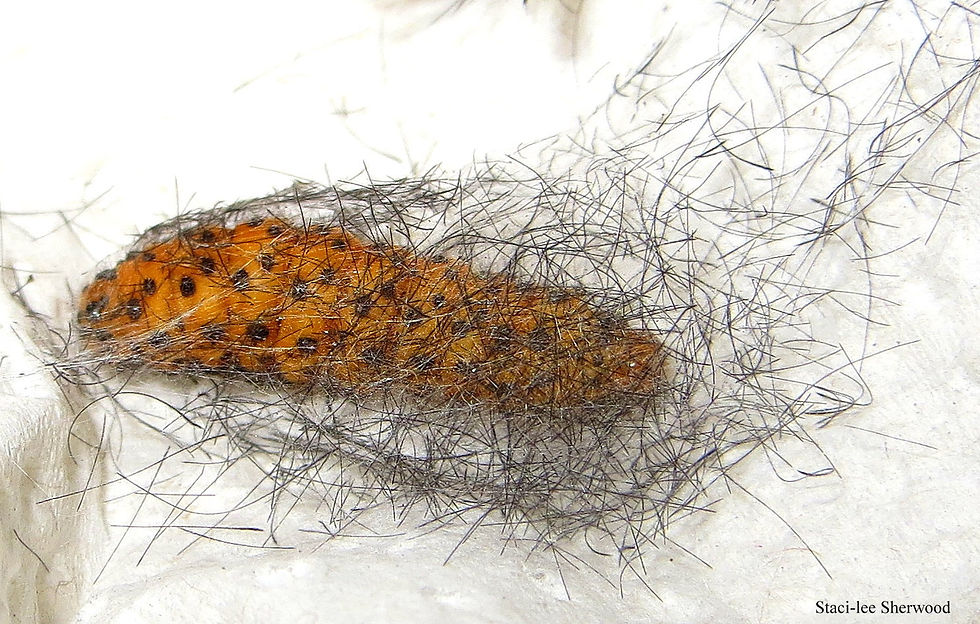
Some moth caterpillars look like they’re covered in flowers like this Buck moth caterpillar

Two different caterpillars of the Pluto Sphinx moth. They are grown and ready to make their cocoon

Newly eclosed Pluto Sphinx moth, almost has a velvety look

Newly eclosed Tersa Sphinx moth, almost looks like wood

Edwards wasp moth cocoon on my door

Silk moths
Silk moths belong to the Saturniidae family and have no mouth. They use their fat reserves for energy. Like all moths their lives are pretty short, lasting from a few days to a few weeks. Their cocoons are made by using a protein filament spun by the caterpillar to form a protective casing for its pupal stag. This is where the caterpillar liquefies inside the cocoon for their transformation to moth. Their cocoons are spun with a silk thread.
Unfortunately for silk moths their cocoons are highly prized in the fashion world. Clothing made from real silk is pricey and carries a symbol of status for some. To get the silk from cocoons billions of silk moth caterpillars are boiled alive until they die. Once dead the cocoon is unraveled to make silk thread into clothing. It’s estimated that 2000 – 3000 cocoons are needed to make one pound of silk. China is the largest producer dominating the market with an 80% share with India being the second largest producer. Neither country has any animal, environmental or worker safety laws. If you care about the ecosystem or are disgusted by this process, as I am, you won’t buy silk. There are better fabrics that don’t involve this type of unnecessary torturous death.
Click here to find fabulous cruelty free silk alternatives
A Polyphemous moth, a silk moth, rests under a light

The stunning lime green Luna moth belongs to the family of silk moths and has no mouth

Luna moth cocoon. Photo credit Dean Morley

Nature didn’t make silk moths for human clothes. They’re part of healthy ecosystem and should be left to live free from a cruel unnecessary death.
Day flyers & pollinators
Not all moths fly under the cover of darkness. Some live out in the open and are brightly colored while others blend so well with leaves and branches their camouflage makes them almost invisible. These day fliers prefer to rest under a leaf, branch or blade of grass, unlike butterflies which typically rest on top of leaves, flowers and branches. This makes them a challenge to see and photograph and probably why so few people are aware of their presence.
Moths have fur not scales and are better at pollinating than butterflies. Their fur grips the pollen making it better at carrying it. We think of bees and butterflies as the best pollinators but moths, wasps and flower flies are also great pollinators and extremely beneficial to a healthy ecosystem. Many species of moths, such as the Clearwings, Hawkmoths and Snout mouth are day flying and pollinate.
Here is the Orange-spotted flower moth, barely over 1 inch tip to tip, on Spanish Needle
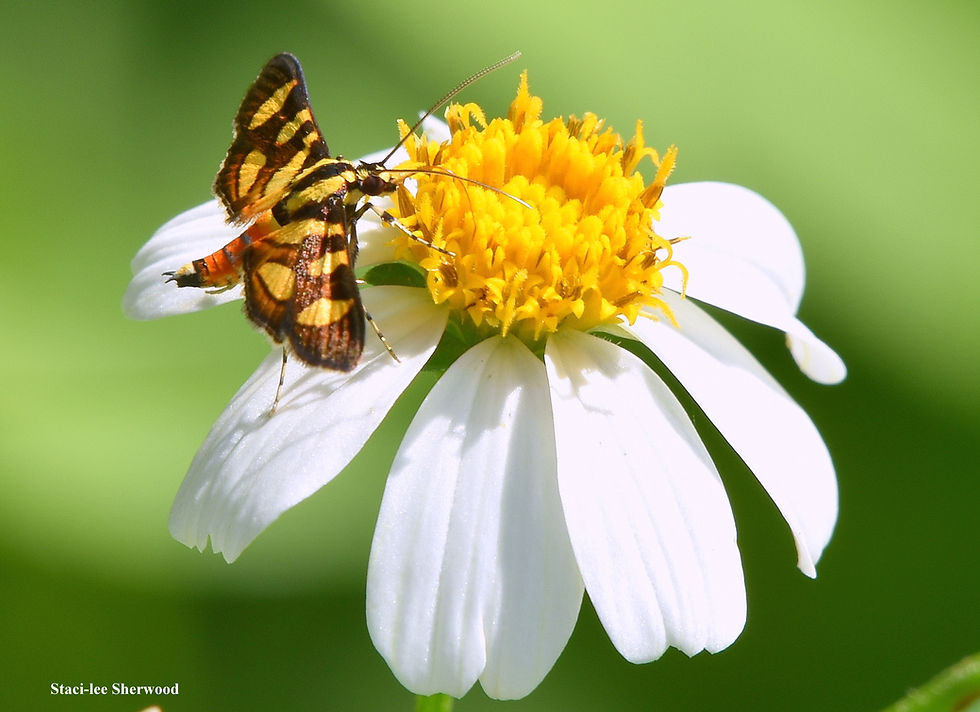
This Clouded Crimson is stunning and only about 1 inch long

A Speckled Renia moth hides in plain sight blending in perfectly with the leaves

The Orange Holomelina moth is one of the smallest measuring less than 1 inch from wing tip to tip. Its bright neon orange and blue eyes are hard to miss when perched out in the open

This Spanish moth is pretty in pink and black measuring less than 2 inches in length

How to help them survive
Never use pesticides they’re toxic to everything including us and stay in the atmosphere forever.
Look up what species live in your area and plant native organic non gmo host and nectar plants for them
Before buying any plants or seeds ask if any plant has been sprayed, most nurseries do spray plants but there is rarely a warning label. Many organic nurseries do not spray the plants themselves but don’t always know if the grower/shipper has sprayed them. It’s best to buy butterfly plants from a nursery that grows them. If that isn’t possible next best thing is to keep any new plant covered for 2-3 weeks so any residue wears off.
Be careful when watering plants, never use a strong stream on them instead water from below
Look for eggs and caterpillars before doing any pruning of plants
Look for caterpillars and cocoons before removing any pots, leaves or branches as they prefer to use those areas to make their transformation
Remove any leaves covered in mold or mites as that can make the caterpillars sick
Caterpillars that vomit green have consumed leaves with pesticide residue and won’t survive. Unfortunately the most humane thing is to remove them and end their suffering. This also means the plant has been sprayed and not a good food source for other caterpillars.
Get local schools involved in planting a moth/butterfly garden. It can be a living science lab and a boon to education
Click here for a great resource on region specific plants, restoration and establishing a pollinator habitat
Click here for more info about moths and to participate in a Moth Week event
Also published on All-creatures on December 31, 2025
Also published on The Good Men Project on January 19, 2026


Excellent article on the beautiful differences between moths and butterflies. So much to learn