Public Sea Turtle hatchling releases can be deadly for hatchlings


By Staci-lee Sherwood
Going to a Sea Turtle hatchling release might seem like a harmless sublime way to spend an hour on the beach, but it’s not. Tickets are sold months in advance, long before the female lays her eggs. No one questions how places like Gumbo Limbo or Ann Kolb Nature Center would know they’ll have hatchlings to release on a certain date months in advance, but they should question that.
I worked for the state of Florida from 2008 – 2019 doing research and rescue of Sea Turtles. During the early morning beach surveys I excavated hundreds of hatched nests and sometimes we would have stragglers. Those are the hatchlings that didn’t make it out of the nest at the same time as the others. During my state required field training one of the state requirements was to NOT release any hatchlings into the ocean after sunrise. This protective measure was done for the obvious reason that hatchlings are tiny dark spots clearly visible in daylight and make an easy target for predators. Normally the nests hatch late at night under the cover of darkness making for a safer journey to the ocean.
The natural way hatchlings make their way to the ocean
Hatchlings in the nest are designed by nature to hatch at the same time. They need the full force of each other trying to crawl their way to the top of the nest. This clawing at the sand pulls the sand down creating a divot or bowl like impression as the hatchlings start to pop their heads out of the sand. Once they have all hatched those on the bottom push those on top of the nest up and out as they all rush toward the ocean. This burst of energy only exists when they are newly hatched. They need this to help them swim over the waves, against the current and out to the Sargassum where they live for about five years.
If the hatchlings do NOT make it out of the nest with the others, some don’t hatch until hours later, they’re what we called stragglers. Some stragglers would crawl up the nest and toward the ocean on their own the next night. Others were dug out by people like me when we excavated a hatched nest. Any stragglers we found in the morning were released that night into the ocean. We knew they probably lacked the same burst of energy but we gave them a chance.
An endangered Hawksbill hatchling
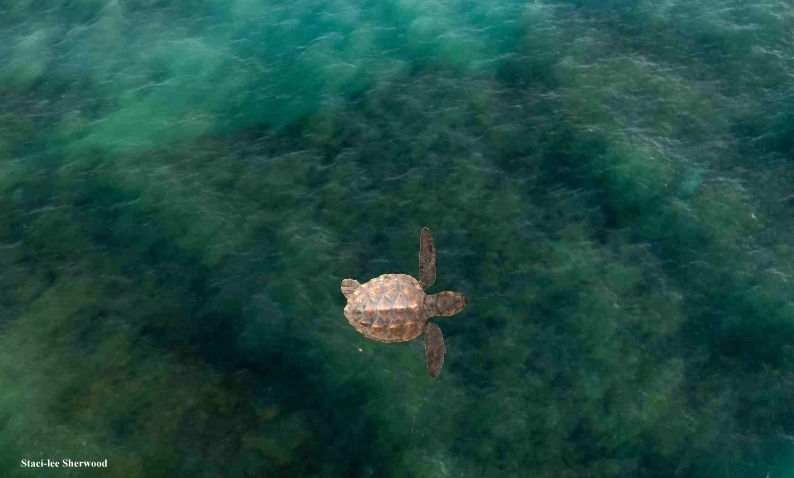
What really happens at a public release
Now think about the public releases. Tickets are sold months before a hatching . The days leading up to the public release any hatchlings found in hatched nests are kept in a water tank until the public release. They’re not fed. Many are kept for several days as releases aren’t done every night. Think how you would feel languishing in a tank for days only to be poured out of a bucket where you have no idea what’s going on. Most hatchlings have to be coaxed to move due to lack of energy. Most releases are done early evening when it’s still somewhat light out. The light pollution causes hatchlings to disorientate, get confused, and either walk toward the light or freeze.
The public has no idea this is cruelty not conservation. That’s just PR spin to assuage the public into thinking this is harmless.
Having spent years on the beach at night rescuing hatchlings confused by the bright lights, I’ve seen the damage done by these public releases. I’ve had to rescue many of those same hatchlings, released just an hour before, as they washed back. Whenever there was a public release I would walk by 30 minutes afterward looking for washbacks. A washback is a hatchling too weak to swim over the waves. They keep getting washed back onto the shore until they die from exhaustion. Too many hatchlings die as they keep getting washed back after trying to fight the waves. Any rescues would get a boat ride out to the Sargassum because they were too weak to swim.
It’s a tragedy that every marine biologist in Florida and every group that does releases knows but does nothing about. All marine biologists working with Sea Turtles have the same training as I did. They know better but the public releases are a money maker. More to the point they give the appearance of prestige.
That is not conservation but exploitation.
Going to these public releases only perpetuates this tragedy at a time when all Sea Turtle species have massive population decline. Add to that the fact that most hatchlings never even make it to the water due to light pollution up and down the coastlines of Florida. A fact the FWC and all these groups shield from public knowledge. All stragglers should be released the night they’re recovered not days later at dusk as a public spectacle.
If you want to see live hatchlings you can take photos of go to Loggerhead Marinelife Center in Juno Beach, Florida. They always have them during hatching season which runs from May – October. An endangered Green Sea Turtle hatchling washback awaits his boat ride out to the Sargassum

If you really care about our endangered Sea Turtles let them have the beach to themselves and do NOT participate in fraud. Once they’re gone they’re gone forever.
Also published on The 7 & Beyond on Substack on August 5, 2026


It is amazing how some people proclaim they have tons of conservation in Florida for various species and have never discovered that FWC actively ignores or never has enforced violations against endangered species. Making a suggestion to report the incident to FWC leads me to believe that the person who has done tons of nest work for a decade, lacks credibility.
Hi Staci-lee Sherwood, I appreciate your work, but I've done tons of nest evaluations, and none have been done as you describe.
I've been doing them in Brevard County for over a decade, and hatchlings are only released during a nest dig from the nest they just came out of and only if they are healthy and strong. If they are not healthy to release, then they are taken to rehab or to rest until nightfall, then released. They must be accessed by a stranding person to verify rehab or just rest.
If one of the permitted groups is doing it differently, it may be worth reporting to FWC, as they also do not condone most of the process you…