Why do we love the Doves but hate the Pigeons?

Updated: Aug 31

By Staci-lee Sherwood
Why do so many people think doves symbolize peace and love but equate pigeons with filth and trash? The irony is that all the trash in the parks comes from the human visitors not the pigeons. Our native doves like the Mourning and Ground Doves belong to the same family as the Rock pigeon, Columbidae. While the cooing of the Mourning Dove brings a smile to many the sight of Rock Pigeons often draws a negative reaction. While pigeons and doves may prefer to nest in different habitat or eat different things in appearance they are clearly related. Pigeons are a larger heavier version than doves but are just as colorful and graceful as their slender cousins. It seems odd one species brings a smile while the other a grimace.
We domesticated pigeons about 10,000 years ago during the Pleistocene era. Ancient Egypt used them in ceremonies. Pigeons were bred for food then later on for carrying messages. Most unique is they’re being the first bird to be domesticated by humans and one of the first animals. Their life history has intertwined with ours for thousands of years so we should view them with reverence not disgust.
A Rock Pigeon shows off his green and purple feathers

History of Rock Pigeons in the U.S.
The Rock Pigeon, the main species people think of when they hear the word pigeon, was brought to the US in the early 1600s by settlers as a food source. Their diet primarily consists of a variety of seeds, grasses and grain with the occasional fruit. If they’re scrounging for human food scraps it’s probably due to lack of their own natural food and not a preference. This is especially true for city pigeons living far from their natural woodlands habitat. Tossing stale bread or other processed human food doesn’t help them, it actually hurts them. Just like with Raccoons, if you truly want to provide a nutritious snack for them put out seeds close to what they normally eat. This provides real food and triggers their instinct to forage for what their bodies are designed to eat.
Contrary to popular belief pigeons are not a major cause of spreading disease to humans. The fact is people are the biggest vector for spreading to disease to other people, not animals. It’s rare to have a disease that is zoonotic, meaning it jumps from an animal to a person. Yet pigeons get blamed for something they have no part in. Back in the 1960’s New York City actually went to war with them. New York City Parks Commissioner Thomas Hoving coined the phrase "rats with wings" falsely blamed them for spreading meningitis and wanted to exterminate them. Scientists proved that contacting meningitis via pigeon dropping was exceedingly rare, it’s almost always spread by people coughing. The damage was done and while most people know better the lies persist.
While the black and grey color scheme is the most common some Rock Pigeons come in all or mostly white. This pigeon was the star of Green Cay wetlands down in Florida for her unique coloring.
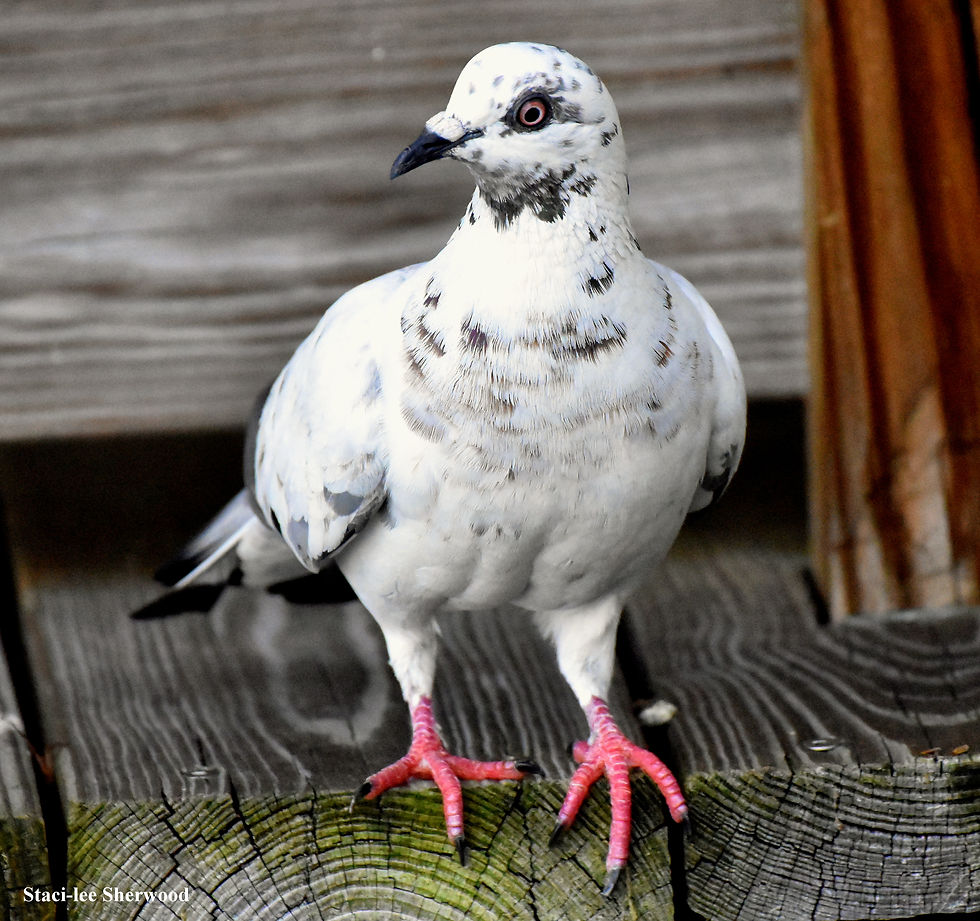
Here’s another black and white beauty

Family life
Rock pigeons are by nature cliff dwellers, which is why they prefer to nest on a building ledge or on the beams of bridges, tunnels and boardwalks. They don’t want to nest near people but it’s where they find the structures most suitable to nest on. In warmer states they can nest year round having more than three nests a year, while in the north they nest in spring and summer. The female lays one or two eggs and incubates for less than three weeks. The chicks grow fast and fledge about three weeks later once they have their flight feathers.
A male first nuzzles a female

If she reciprocates they lock their beaks together and bob their heads up and down in a synchronized dance followed by brief mating

A female sits on her eggs for about three weeks

The chicks are born covered with bright yellow feathers which slowly shed as they grow

This chick contemplates her first flight after nearly a month in the nest. The chick’s feathers are more muted than the adults

The native White-crowned Pigeon
The Rock Pigeon may get all the attention but the US is home to a several native pigeon species. The White-crowned Pigeon is rare beauty. They’re found only in a few spots down in the Florida Keys and is protected by the U.S. Migratory Bird Treaty Act and as a State-designated Threatened species. Habitat loss from development and degradation from construction, pesticide use and pollution contribute to their declining population. Food has become more scarce and safe places to nest are being torn down. They prefer to roost and nest in mangrove trees, also an endangered species, and enjoy fruiting trees.
The elusive adult White-crowned Pigeon

How to help educate people and help pigeons
As you see pigeons are like other wildlife just trying to survive in an ever increasing hostile world. They’ve been vilified, like wolves, for no legitimate reason. Educating those that only know the lies they’ve been told is the first start. If a pigeon nests on your window ledge it’s because that is where they naturally nest, on cliffs and ledges. Our buildings have become a nesting habitat for city pigeons. Imagine trying to find a place to raise your offspring, you find a seeming safe place and make a nest only to have it destroyed by someone that falsely thinks you bring disease or trash.
A pigeon’s natural diet consists of seeds, grain and grasses so if you plan to put out food use seeds designed for them
Never feed them stale bread, it’s not digestible and loaded with chemicals
Cracked corn, unsalted sunflower or safflower seeds work best
If you absolutely can’t have a pigeon nesting on your building do not put out poison. That’s a cruel slow death and can be consumed by other animals as well. Use a human method of deterrence by putting:
Vent Covers: Capping chimneys and blocking loft or vent openings securely prevents pigeons from nesting inside the structure.
Bird Spikes: Installing non-lethal plastic spikes on your ledges,
Netting: Using heavy-duty bird mesh or netting over large open areas
Also published on All-Creatures on July 15, 2026
Also published on The Good Men Project on August 31, 2026


Comments