Silent Spring is already here despite 60 years of warnings

By Staci-lee Sherwood
In 1962 biologist Rachel Carson wrote ‘Silent Spring’, a landmark cautionary tale on the dangers of pesticide use. Despite the past 60 years of warnings, studies and the creation of the EPA (environmental protection agency) her prediction has mostly come true. Growing up in New York winter was always more quiet but never silent, we still had winter birds. Spring came not just with a warming sun but with a cacophony of songs, chirps and squeaks from all the birds returning. There were too many birds to count. That is no longer true. Along with birds there were billions of butterflies, caterpillars, moths, squirrels, chipmonks, fireflies and thousands of other species of insects. Part of their role was to provide food for birds.
As widespread use of pesticides went from the farm to everyone’s lawn the side effects of these toxins spread far and wide. It poisoned not only insects, which led to starving birds and sterile eggs, but also a growing lifeless wasteland. Add to that the trend of planting non native flowers and vegetation that require massive amounts of chemicals to grow and you create a toxic brew. All these pesticides go into our drinking water, soil we play and grow food in and air we breathe. Silent spring wasn’t just about the death of birds but also our own demise as the chain of life grows ever more toxic.
Losing our birds faster than we think
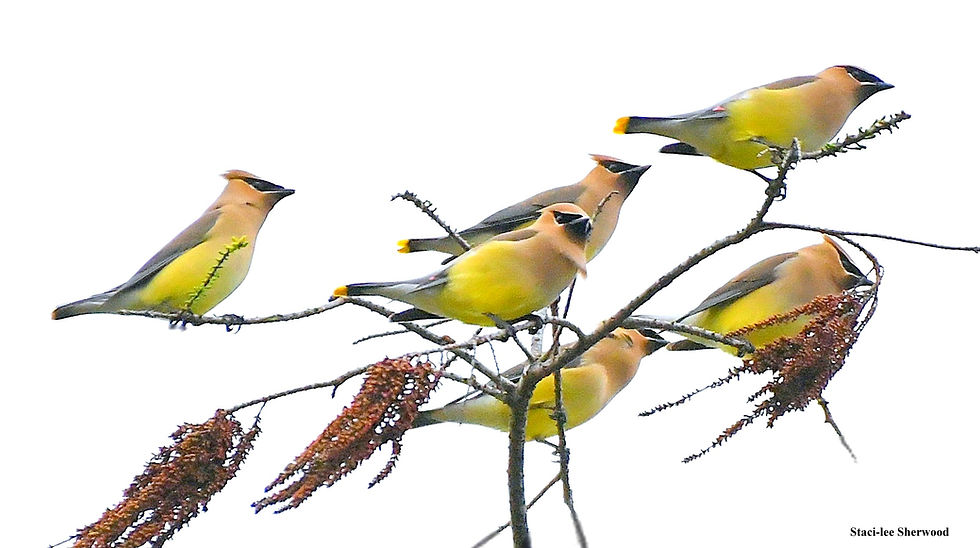
The cover shot are Cedar Waxwings who migrate down to Florida for winter. They feast on berries and fruit and supplement with insects. As pesticides douse the sky, their toxins blanket everything. Over time this kills many trees and weakens others to where they’re no longer healthy enough to produce berries or fruit. Waxwings travel in flocks so finding a big source of food is paramount for them. They make a spectacular photograph because they’re so exotic looking. This makes them easy to spot and easy to notice when the flocks aren’t as large and their stay is shorten due to lack of food. Birds that don’t migrate as a flock are easy to fall under the radar. Keep in mind with migratory birds even if you see a large flock in one area that doesn’t mean there are large flocks in all their historical breeding grounds. Some local populations may increase while overall population drops.
Studies written in the 1980s and 1990s predicted a decline further into the future. We now see the decline of species happening faster than previously thought often losing species before we know they’re in trouble. For example a study done in 2025 by the University of Oxford found that wildebeest populations were half what were previously thought. These are large animals traveling in huge flocks and easy to see. Imagine trying to calculate hummingbird or warbler populations.
In 2019 ‘State of the birds’, was a landmark study with shocking findings. It looked at overall populations over 50 fifty years and found we had lost 3 billion birds just in North America. While pesticides weren’t the only reason they play a huge factor. Populations aren’t just in decline, that decline is accelerating. Future generations will never experience the springtime songs of past generations.
The report included economics impact of bird watching. With 100 million Americans involved in these activities they found their contributions to local and state economies were substantial. It drew findings from the 2022 National Survey of Fishing, Hunting and Wildlife-Associated recreation and discovered that bird watching activities had an economic output of $279 billion, yes billion, and supported roughly 1.4 million jobs related to them. We lose the birds we also lose that income.
Click here to read the report
Great Blue Heron breeding populations have declined nearly 11% between 2011 – 2021, some areas have dropped by 40%. Down in Florida in areas where I used to see several breeding pairs I now only see one or two birds and this is true throughout the state. Below a mated pair greet each other with a mating dance by their nest

Yellow-rumped Warblers, a small migratory bird, population has declined by 9.6% between 2011 - 2021 and up to 50 % in coastal areas like North Carolina and Texas. Here a female perches

Statistics can be politicized to make it appear less of a decline that it is. Developers and government officials bought by them practice this slight of hand all the time.
A Tree Swallow goes after a dragonfly. Swallows, like purple martins and flycatchers, only feed on flying insects. These insects are the most vulnerable to pesticides because they are the first to be sprayed on, literally. This species has seen a 20% population decline since 1966

Ruby-throated Hummingbirds depend on native flowers for nectar and insects for protein. Statistics say their population is stable but how accurate can a count be of a migratory species that’s lightning fast, only 3 inches long and lives 3 – 5 years? I remember seeing many more hummingbirds just 10 years ago. Pesticides kill flowers, less flowers less hummingbirds

A family of Sandhill Cranes forage for insects. Their population may have increased over the years but their food source has drastically dropped off. At some point the crane populations will reflect that loss

Great-horned Owl siblings wait for parents to drop off a rodent for breakfast. Owls are nature’s natural rodent control and thousands die every year from ingesting rodenticides like rat poison. The North American Breeding Bird Survey recorded a 33% decline in North America from 1966 to 2015. As their food vanishes from the widespread use of rodenticides their population will also decline as this is a major food source

A tiny Common Moorhen chick, once seen all over Florida in sustainable numbers is no longer a common sight. In 2007 I saw these waterfowl all over the state, where there was water you could find them. While statistics say their population is stable I’ve seen a drastic decline in them, along with their cousins the American Coot and Purple Gallinule. All of them once commonly seen in lakes, rivers, canals and ponds have now vanished or are seen in singular numbers not large groups. Herbicides sprayed into the water is a huge factor

Open space vs development
Open space isn’t just habitat for unseen wildlife it’s important to our well being. In 2024 a study done by Harvard showed how being outdoors improved our mental and physical well being, and how the disconnect from nature is detrimental to us. City dwellers often spend the weekends in the country. The fast paced concrete jungle is not a place for quiet time to unwind, that what nature provides free of charge. The only fee is to not destroy it.
Click here to read the study
There’s a growing movement to protect what little undeveloped land is left. Why destroy what little green space we have for ugly buildings? Developers see any open space as a wasteland, often lying about its value and health to move their projects along. They view land through a financial lens and have co-opted many state agencies in an effort to streamline and nullify any law that hinders them. Some states like Florida have tried to remove local communities from objecting to sprawl.
Most people see this as natural beauty that warrants protection. It’s a living habit for mammals, birds, reptiles and insects and a quiet haven for people. Developers and politicians see this as a future subdivision or shopping mall they can make millions from. That is the fundamental difference to overcome

Trading open space for subdivisions and data centers. Once open forest is destroyed every living creature dependent on it vanishes too.
This had been wilderness just last year filled with lush green trees and shrubs not that long ago

Destroyed for another data center in Florida

It’s not just birds but all creatures are impacted
The chain of life involves all living creatures including us. Removing just one species has a domino effect, often not seen until years later. As tragic as it would be to lose birds it would have a devastating effect on the entire ecosystem. Pesticides kill everything, so their use also kills off the food of birds and many other species such as; owls who keep rodent populations down, pileated woodpeckers who eat termites, dragonflies who eat mosquitoes, small birds who are food for hawks, eagles, kites and fox. Herbicides sprayed in water kill frogs, fish and water snakes. All of these are also food for birds of prey and osprey. It won’t just be silent spring but a silent world.
This Gray Fox eats many insects, small birds and rodents. All are targets for pesticides. When his food vanishes so will he

What can be done to help
Here is the best advice for trying to slow this decline down
Plant native non GMO wildflowers, trees, grass and shrubs. Make your garden an organic living habitat
Never use pesticides (or herbicides or rodentcides) they kill everything that comes in contact with them and stay in the air/water/soil forever
Educate others, your neighbors, HOA’s, coworkers because very few people really know what’s going on or why
Attend public hearing whenever there is a development project in the works
Get in touch with your local/state and federal government officials (both employed and elected) and let them know you want an end to using pesticides as it’s rarely ever needed.
If aerial spraying occurs contact your county government, it’s usually done through the county environmental department and request a public hearing on aerial spraying. In some areas you can request to not have your home doused with chemicals.
Also published on All-creatures on May 6, 2026
Also published on The Good Men Project on May 23, 2026


Excellent essay that should motivate people to do something significant to stop these destructive behaviors and lifestyles!
As someone who follows your blog regularly, I really appreciate how you make environmental issues feel personal and real through your writing. This article was powerful because it connected scientific facts with your firsthand experiences observing birds and wildlife, making the decline of species feel urgent and impossible to ignore.